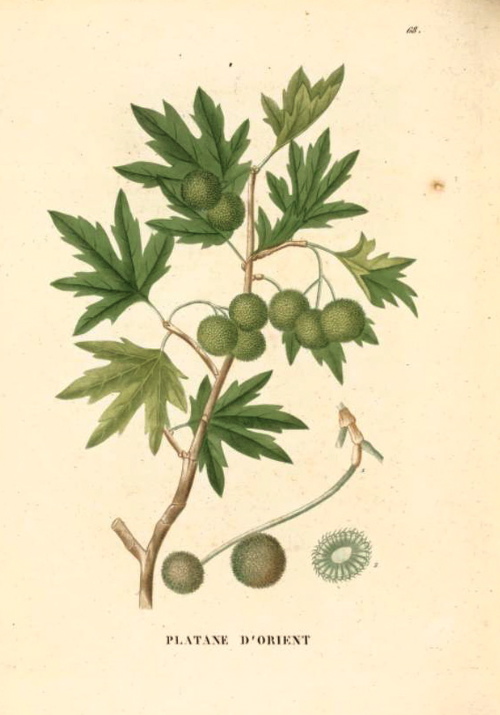
Eastern plane tree (Eastern plane tree)
Appearance: A tree that sheds its leaves for winter, usually very impressive, grows up approximately 30 m in height. Crown mostly very wide and repeatedly vaulted, therefore, it appears irregular and overexposed in places,
Lower branches often strongly hanging, sometimes they touch the ground. Branches of the middle and upper zones of the crown steeply erect or straight protruding.
Straight trunk, usually quite thick, clearly visible only to the first branch, and then divided into numerous, very massive boughs, often also with thick, disc-shaped growths.
Smooth bark, brownish, falls off with palm-sized lobes. Shoots light brown, hairy, Short-pointed donuts, about the length 5-7 mm, brown, with reddish-brown hair.
Torsion leaves, May 12-18 cm in length, are almost as wide. They are usually divided into five, less often for seven flaps, indented very deeply, beyond half the width of the lamina, Individual flaps are long sharpened, uneven size, always longer than wider, with sharp teeth. The leaves are initially slightly pubescent, however, they go bald very quickly; on top shiny resin, brighter underneath, Petiole with onion thickened root,
Female flowers numerous in spherical flower heads, set three to seven on long peduncles, which at the time of fruiting reach a length of about 15 centimeters.
Male flowers also in spherical heads, however, much shorter.
Occurrence: Originally only in Turkey and the Balkan Peninsula. In Central Europe, planted rarely; relatively common in Southern Europe- for shading.
Flowering period: Maj.
General thoughts: Both in terms of habit and foliage, plane trees look quite similar to different representatives of the Maple family, to which, however, they are not closely related. However, you can both types, Platanus and Acer (maple), clearly and reliably distinguish by several easily recognizable features. Shoots, donuts (winter aspect I) and the leaves are generally twisted in plane trees. In the winter aspect, only one hooded scale is seen on the buds of the plane tree, while in all maple species the opposite leaf and flower buds are always surrounded by numerous scales, At the end, in the leaves of the lobed draws attention deep, gutter hollow in the lower part of the petiole (leaf base) – it almost completely covers the buds prepared for the next growing season so, that before the autumn fall of leaves, it is almost impossible to recognize them. The petioles of the maple leaves are smooth and devoid of gutters up to the root.. A certain distinguishing feature of plane trees are pieces of bark falling off with large patches, as a result, characteristic spots and patches are visible on the trunk,
A related species:
Western plane tree (American sycamore) is a tree reaching approximately 40 m in height. Leaves usually three-lobed or only weakly marked five-lobed. Middle flaps much wider than longer ones. Leaf margin smooth or sinus-serrated, much shallow indented than in the eastern or maple leaf plane. On the underside of the leaves grow in the axils of the nerves small bunches of hairs. Spherical fruiting bodies occur mostly singly, rarely two on long, hanging peduncles. Sheeted wood has a very beautiful striped grain pattern on the cross-section and can be processed into noble veneers.