Noble fir (Abies tall)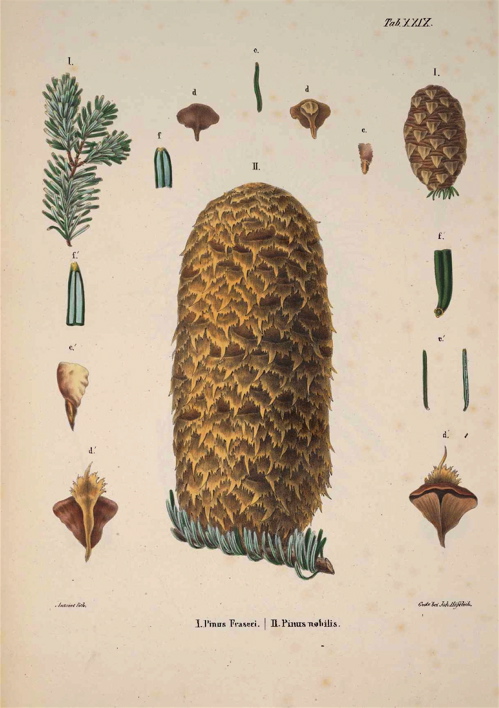
Appearance: An evergreen coniferous tree with a slender cone-shaped crown, more and more columnar with age, sometimes quite wide in very old trees. In his homeland, he grows up to 80 m in height.
The bark of young trees is smooth, and silvery gray to slightly reddish, cracked gray-brown in older specimens. Young shoots gently pubescent, reddish brown.
Pins set at the bottom of the crest. in the upper – very densely, double-breasted and clearly bent upwards. Firm, quite slender, but with blunt ends, green-gray on top. flat, furrowed, and underneath with two gray longitudinal stripes. Male flowers very numerous on the lower side of younger branches, mainly in the upper zone of the crown, initially they are bright carmine red, they become light yellow in the process of dusting, spherical with a diameter of approx 6 millimeters,
Female cones – vertically positioned on thicker branches inside the crown, less often on younger branches (then generally slightly tilted to the side), initially yellowish, after pollination, they develop into sizeable formations of length 12-20 cm and circumference 5-9 centimeters. Light brown to purple-brown when ripe, cylindrical, slightly pulled at the top, they draw attention with long protruding appendages of individual scales. Cones also develop on very young trees – but only in the refined forms of 'Glauca”. Occurrence: The homeland of noble fir is the western areas of North America – primarily the natural mountain forests of the Coastal Mountains in Washington and Oregon. Flowering period: Maj, in areas more to the south – a few weeks earlier.
General thoughts: Noble fir – unlike her numerous North American relatives – in Europe it is hardly ever grown in forests, however, it is quite often planted in gardens and parks. The most common is the cultivar variety with silver-to-blue-green pins, called silver fir by gardeners.
A related species:
Fir balsam (Abies baisamea) it draws attention with its very slender, a pointed crown with a conical end. Its homeland is vast areas of North America – from Canada to Virginia. Pin length approx 2,5 cm, are slightly jagged or dull at the front, shiny dark green, underneath with two distinct silver stripes. The bark of young trees has quite prominent resin bubbles, delivering very clean, light yellow resin. This substance, commercially known as Canada Balm, has long been used in microscopic technique as a fixative and is still used today despite the invention of synthetic products. Balsam fir is an important species that provides building wood. It is rarely planted in parks, however, usually present in large forest collections,