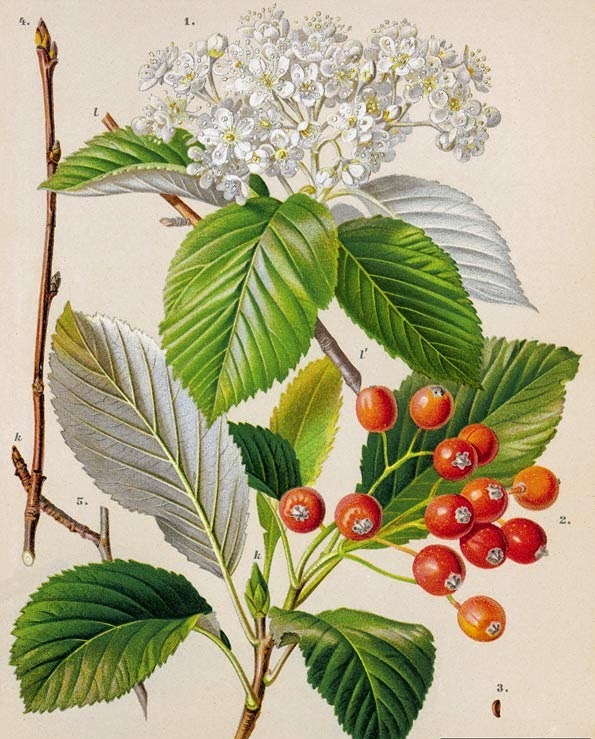
 Mealy rowan (sorbus aria)
Appearance: A tree that sheds its leaves for winter, grows up 5-12 m, with very wide, a flat, vaulted crown built quite irregularly. The trunk is quite simple, with branches not bent, directed radially upwards.
Branches very loose and irregularly arranged. The bark of younger and older trees is quite smooth, gray-silvery or dull gray, with age, however, it becomes more and more cracked or slightly exfoliated. Strong shoots, gently at first, silky hairy, darker on the top than on the underside, Quite big donuts – about 2 cm in length – ovate, only hairy on top, greenish.
Leaves not divided, about the length 6-12 cm and width 5-7 cm, oblong-oval, wedge-shaped or rounded at the base, very irregularly serrated. unevenly doubled or nearly lobate. On top of the leaves, silky pubescent, but later naked and intensely green; always covered with dense underneath, white cutter. Flowers in loose, do 8 cm wide, flat vaulted podbaldach. Individual flowers approx 15 mm, they grow on peduncles, they are pure white or slightly creamy.
Apple fruit 10-15 mm in length, ovoid-spherical, usually bright red in color.
Habitat: The flour rowan is a light-loving tree plant, which, however, abolishes partial shade. It grows well in moderately dry and warm enough soils,
Occurrence: It grows wild everywhere in Western Europe: it can be found in sunny forests and thickets, It creates numerous forms. Because of the felt hair on the leaves (they grab the dust!) it is often planted in cities along streets or along communication routes.
Flowering period: May to June.
General thoughts: The small apple fruits of the flour rowan are almost not harvested in early autumn by birds and squirrels – no doubt because of the bright red color. Therefore, they stay on the tree late and can often be seen even in winter. After the first night frosts, the color gradually changes to darker and finally turns into a shining dark red. Only then are the apples eaten by various migratory birds or squirrels waking up from hibernation.. From an ecological point of view, such woody plants form a group extremely important for the winter nutrition of smaller vertebrates. The fruits of the flour rowan are slightly poisonous in their raw state due to the content of parasorbic acid. In the past, they were collected in times of poverty, dried and made into flour (hence the name!), which was used as an additive in baking bread. When heated, parasorbic acid decomposes to a great extent, so that the fruit can be eaten in small amounts.