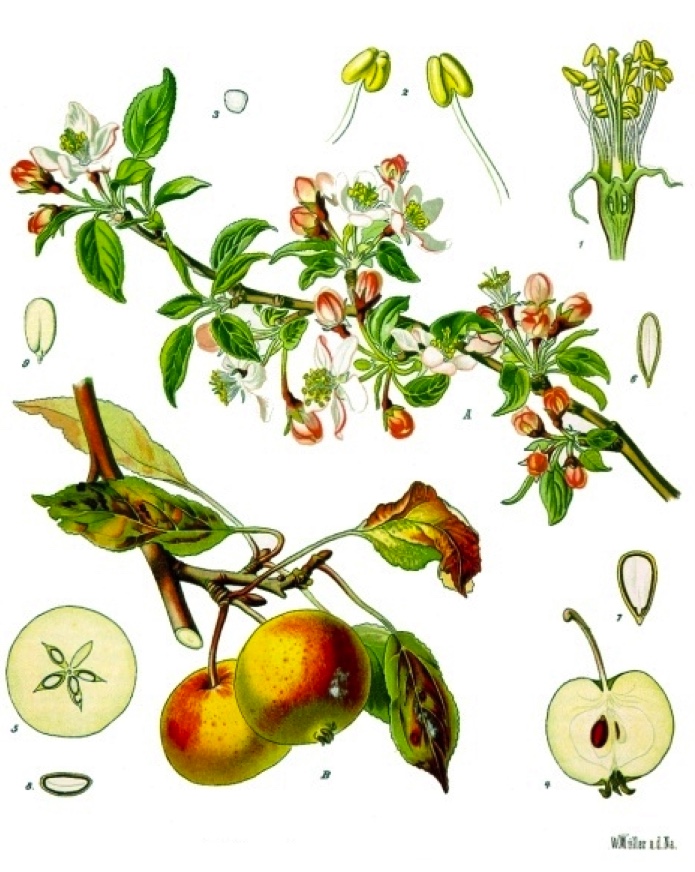
 Wild apple tree (Malus sylvestris)
Appearance: Shrub or smaller aiming tree 5-10 m in height, and a very dense crown with numerous highly branched branches on the low, often bent and twisted trunk. Branches often with numerous thorns.
Brown or gray-brown bark, usually on younger trees, it is strongly cracked and scaly.
Leaves twisted, in outline they are roundish or rather oblong-elliptical 4-10 cm in length and up to 5 cm wide, are broadly rounded or wedge-shaped at the base, narrowly pointed at the front, notched or finely serrated on the edge. The top of the leaves is dull and greenish, the underside is lighter and usually naked or only slightly hairy (unlike cultivars of apple trees). Petioles long 2-3 centimeters. Flowers wide 3-4 cm are pure white or slightly reddish white, especially on the outside. Ovaries fused with each other at the root.
Small apple fruit, spherical, they only have 2-4 cm thick, they are green-yellow and often reddish
Habitat: On deep soils, usually moist and fertile.
Occurrence: It is found in the wild everywhere in Europe, but nowhere is it very common, nor does it form tree stands. Usually difficult to distinguish from feral cultivated apple trees.
Flowering period: April to May,
General thoughts: Wild apples were eaten back in the days of the stilt culture, as evidenced by archaeological finds of seeds, The wild apple tree is the ancestor of many apple tree breeds, grown in different varieties. Numerous commercial varieties, which were known and liked in the past, today it is almost completely extinct, They are replaced by new low foaming trees, high-growing varieties. Old varieties can still be found here and there in old orchards and peasant gardens.
Related species:
Chinese apple tree (A bad sight) has pink flowers, spherical and often even full. It is usually planted as an ornamental shrub in home gardens, on squares and green areas. Flowering apple tree also called Japanese (Bad floribunda) draws attention with its flowers – on the outside strongly colored red, almost white inside. It is also one of the most profusely flowering ornamental apple trees. Its little apples are only the size of a cherry and inedible. Purple apple tree (Malus x purpurea) arose from the crossing of various ornamental apple trees and is beautiful, dark purple flowers. Occasionally it can be found in gardens and ornamental collections. Accurate species determination in ornamental apple trees is very difficult due to the great abundance of species in cultivation, additionally intensified by crosses of commercial varieties. We have limited our description to a few, just, the most common forms.