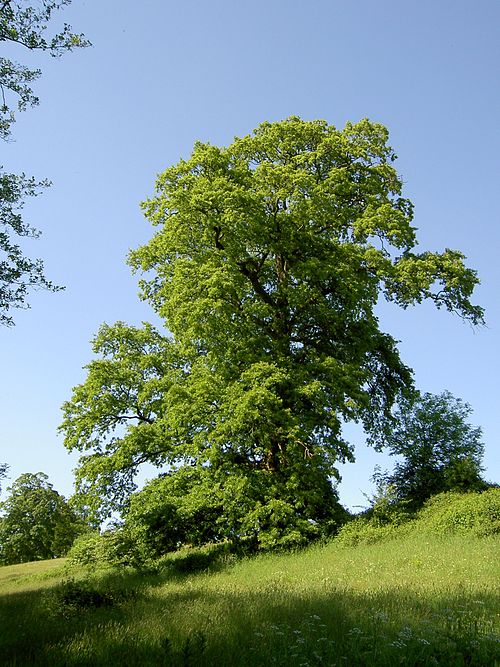
 Burgundy oak (The oak tree)
Appearance: A deciduous tree shedding its leaves for the winter. to approx 35 them in height. The crown is very loose and slender at first, with steep hills, thin, quite regularly arranged branches, while in older trees, it is more vaulted with a spherical outline, with main branches radiating upwards.
The trunk is relatively slender and straight, in the bottom part 2 with not too many branches.
The bark is clearly furrowed on younger specimens, grey-brown, cracked and often falling off with small plates. Stems strong, with a gentle, gray-green hair and therefore looking a bit dull. Oval donuts, quite long and densely hairy, surrounded by durable thread-like scales, pale brown.
Length leaves 8-11 cm and width about 5 cm, oblong, narrow in outline, oval, evenly wedge-shaped at both ends, on both sides with seven or nine differently sized flaps, separated by sharply descending bays. Leaf blades are usually only half indented (lobed), rarely split almost down to the middle nerve (feathered), Round or slightly pointed flaps, with a small notch at the top, often quite blunt though. The upper surface of the leaf is rough and hairy immediately after unfolding, later it bald and then it shines a little. The underside of the leaf is covered with a soft fluff, which lasts throughout the growing season. The leaf petioles are long 0,5-1,5 centimeter. The acorns ripen only in the second year and are hidden almost completely in wide cups, covered with thick scales. Habitat; Burgundy oak prefers soils with silty humus in areas with dry to warm climates.
Occurrence: The actual homeland of this species of oak is the eastern part of the Mediterranean and south-eastern Europe, Its natural range extends to northern Italy. Sometimes this tree is planted in parks and gardens, and sometimes it goes wild. Natural sites in Central Europe are unknown. For climatic reasons, cultivation in forests is therefore only possible in the south of Europe.
Flowering period. April to May. Related species Mossy oak is distinguished by its long length, brownish, quite dense and fluffy with a hairy shoot. Length leaves 10-12 cm are four to seven wide on each side, round flaps. facing the front. They are initially densely hairy on the underside, later – now only on leaf veins. It is planted less often. In Poland, it grows wild only in Bielinek on the Oder.
The wood of Burgundy oak is quite strong and hard. In terms of quality, it corresponds to the wood of most other oaks and is used in the production of furniture.