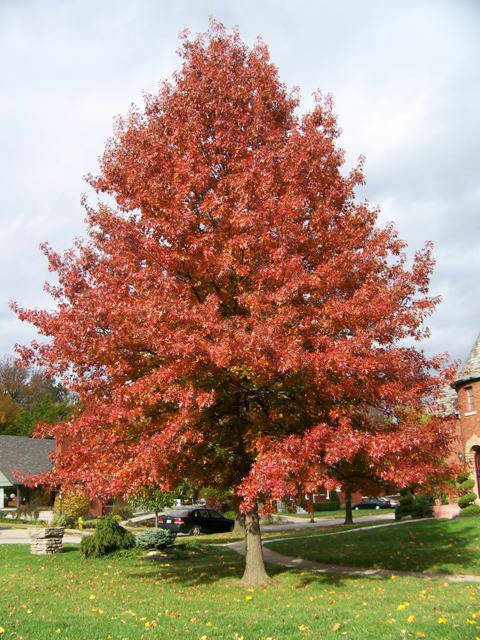
 Mud oak (Quercus palustris)
Appearance Deciduous tree shedding leaves for winter, with a height of up to 25 meters. The crown is quite slender and rounded in younger specimens, narrow and slightly vaulted in older trees, but not that wide and spread out, as with many other species of oak.
The trunk in the lower part is almost always without branches, only in the upper part it branches quite densely and regularly.
Branches relatively thin, with numerous, flaccid, mostly dangling twigs. The bark is initially smooth, light grey, later darker with a distinct streak pattern, and on the older trees, with wide, not very deep and smooth furrows. Shiny shoots, with very bright ones, almost white lenticels. Length buds approx 3 mm, grey-brown, Matt, with numerous scales; oval, unsharpened.
Leaves are round or elliptical in outline 8-17 cm long and are almost as wide. On each side, divided into 3-4 very deeply indented lapels, of which the middle pair is the largest; each flap, in turn, is divided into numerous long hawk teeth. The leaf flaps stand out wide, most of the time, however, they are directed to the front. The sinuses extend to the middle nerve well over half the width of the lamina. The leaves sparkle slightly on both sides, on top they are alive- or dark green, brighter underneath, afe with distinct brown hair tufts in the axils of the leaf veins. The autumn coloration is initially carmine red, later it turns into a deep red wine color, Broadly hemispherical acorns, up to a third recessed in a low cup.
Occurrence: It originally only grew wild in the northeastern part of North America. Because of the beautiful, strongly marked discoloration of the leaves in autumn, Mud Oak is planted in many parts of Europe as a park and ornamental tree, sometimes also along streets or avenues. Experimental cultivation in forests is carried out to a small extent.
Flowering period: June to July,
General thoughts; In addition to the marsh oak, there are a number of other oak species that shed their leaves for winter, whose leaves are very strongly dissected and differ from both our Polish oaks. Species with dissected leaves are difficult to distinguish from one another. Mud oak and scarlet oak (str. 124) they are quite similar. In the marsh oak in the groin of the nerves on the lower side of the leaves there are small ones, dense bunches of hair, which are absent in the scarlet oak. They thus serve as a distinguishing feature. Another, Barwierski oak is quite an outstanding species from this group (Overrus) whose leaves are on the underside more strongly, brownish hairy. Its bark can be used to obtain a dye for dyeing fabrics.
Natural fibers (wool, Cotton) it can also be dyed with preparations made of bark or oak leaves. Depending on the concentration, different are obtained, warm shades of brown and brown, which are very durable.