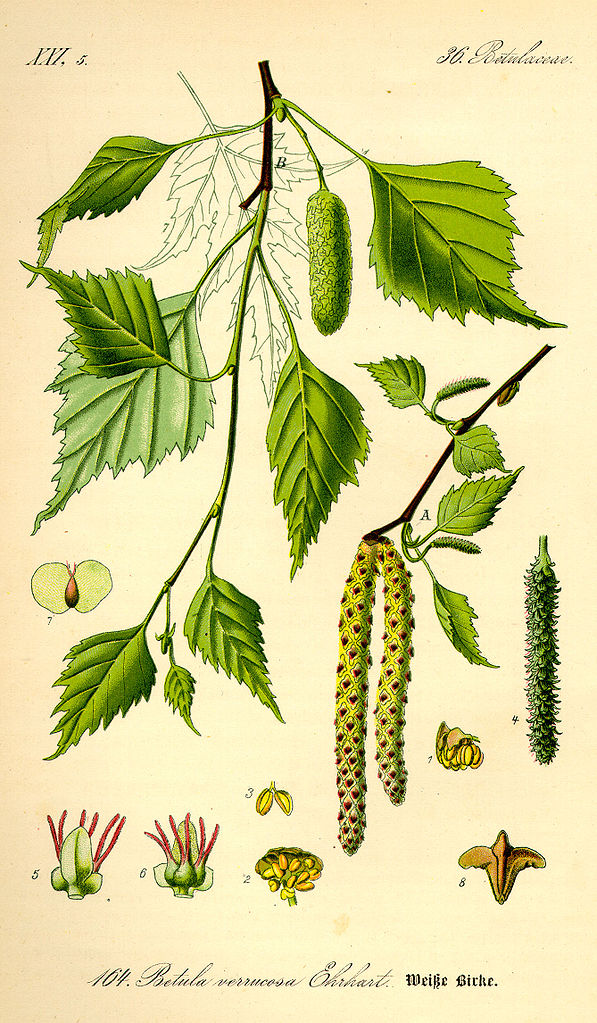
 Silver birch, pendulous birch (United pendulum)
Appearance: A tree that sheds its leaves for winter, usually growing up to approx 20 m in height, although, for example, in the Białowieża Primeval Forest, specimens of height are known 30 meters. The crown is narrow at first, pointed-conical, later it was roundly vaulted and irregular. Straight or curved trunk, sometimes also unilaterally tilted.
The lower limbs are relatively short and clearly protruding, steeply elevated in the middle and upper zone of the crown. Very long and slender twigs, on older trees they hang from the branches like a veil.
Smooth bark, silvery white, with single gray-white crossbands. In older trees – mainly at the base of the trunk – divided into smaller boxes with thick ones, nodular, deeply cracked, black strips, On younger branches, the bark is usually pinkish-white, even shiny dark red-brownish twigs. Shoots covered with small ones, papillary protrusions (the glands), because of which this species was named warty birch, Brownish or shiny green buds, with a length of approx 4 mm, slightly sharpened.
The leaves have 2-6 cm in length, they are round-oval or triangular in outline, sometimes also rhombic. Long-tailed, double serrated, both sides naked, they seem very thin and light to the touch. Mono-tree species.
Male long cats 3-6 cm are initially brownish, later bright yellow, The female cats are greenish at first, when ripe, they take on a bright color- or medium brown. Habitat: A pioneering on loose species, well-lit soils of the initial stage of development; hates even the slightest shade.
Occurrence; It is widely spread everywhere in Europe, especially on sandy grounds, on the frameworks, on the edges of forests or in the mid-field tree stands, In southern Europe it can only be found in the upper mountain ranges.
Flowering period: March to May.
General thoughts: Silver birch, also known as pendulous or white birch, it is by far the most common birch species in Europe. The reason for its wide spread from Southern Europe to the Far North, and also in areas high in the mountains, is its high climatic resistance. The amazingly white bark plays an important role here, which reflects much of the sun's radiation. This is a peculiar adaptive trait, important mainly for trees growing in places with strong and permanent sun exposure. Birch trees spread very quickly on wastelands or on clearings. It is understandable. given the amount of seeds each tree produces. There are several hundred of them in each kitten, which with a medium-sized tree gives several million seeds, because female cats grow quite densely. Airworthy seeds are sometimes carried over great distances by the wind and germinate under favorable conditions the following spring. Birches are used in many ways, Light wood is particularly popular in modeling. The leaves contain various valuable substances and serve as a medicinal raw material. They are both used in folk medicine, as well as in various homeopathic preparations.