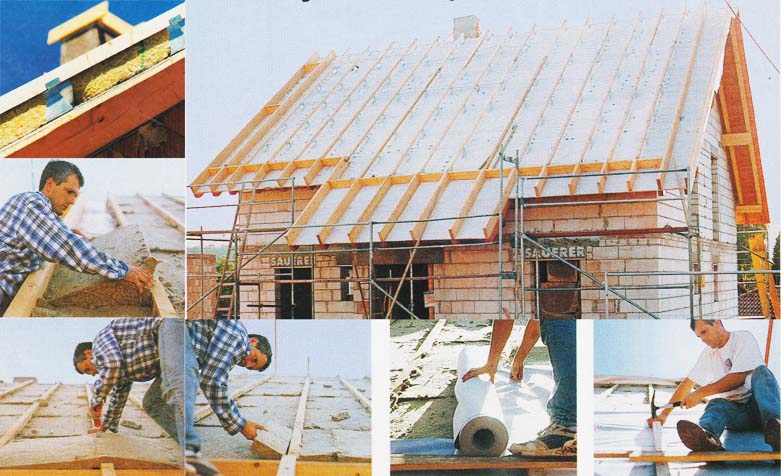
 The insulation that is laid over the rafters is the best in terms of physical properties. Mineral wool boards are arranged in two layers. The advantage of this variant of insulation is this, that the entire rafter cross-section then remains visible, which gives the rooms an interesting rustic character. Except that, nailing to the rafters with wax-soaked plywood boards or boards, we get ready-made ceiling and sloping sheathing, enabling immediate living in such finished rooms. Any other methods of roof insulation involve additional finishing works in the attics.
This example proves, that the thermal insulation placed on the rafters can also be done by DIY enthusiasts, on condition that a suitably simple system is chosen. The workload may turn out to be even smaller than in the case of insulation installed between the rafters.
The advantage of insulation that is laid on the rafters is, among other things, that it is performed entirely, without splitting on rafters that bridge the cold. The cross section above shows, that the lower insulation layer of the Rockwool system used here can be completely installed. Flexirock plate, whose thickness is 120 mm, is arranged with a dimensional excess (on the push), and this is additionally helped by the increased resilience of one of its sides, so there is no need to seal the joints with the roof insulation holders. The space between the "auxiliary rafters" is used to place the second insulation layer of mineral wool boards with a thickness of 60 mm -yes, that the total height of the wool used for insulation is 180 mm. If necessary, its thickness can be increased by a few more centimeters, by changing the sizes of the auxiliary rafters.