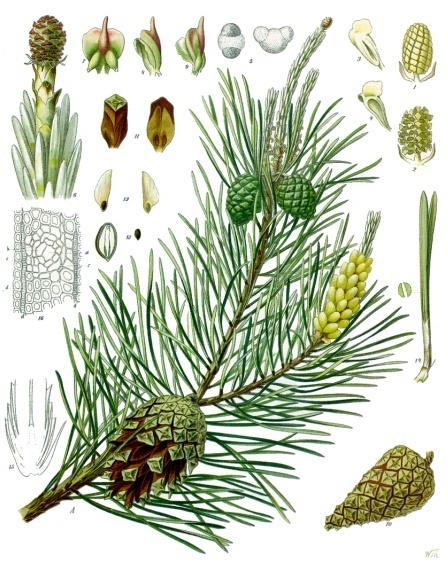
 Scots pine (Pinus sylvestris)
Appearance: Evergreen coniferous tree up to 30 m, sometimes even higher. For example, 350-year-old high pines grow in the Białowieża Primeval Forest 42 m and trunk diameter 160 centimeters. The crown of young trees is regularly conical with a triangular outline, The branches are arranged in a circular pattern. In older specimens, the crown is rather irregularly spherical or even umbrella-like and loosens after lower and ground-level branches fall off.. The trunk is often bent.
Larger branches are almost always twisted and relatively short,
The bark is initially gray or brown-gray, later gray-pink, with age divided by deep, with blackish furrows to large fifths. Initially greenish shoots, smooth, later greenish gray. Oblong donuts with numerous scales are approx 1 cm in length.
Pins after 2 on the shoot they are clustered in clusters at the ends of the twigs, They are long 3-8 centimeters. They are sharpened briefly, slightly flattened and provided with delicate longitudinal furrows. Always slightly longer on young trees than on fully grown specimens, blue- or gray-green.
Female cones grow singly or in bunches after 2-3 on short handles, pointed ovate, when ripe, they are dark brown or almost black, do 8 cm in length, Oblong scales, with slightly convex discs. Habitat: Prefers moderately dry, low-alkaline loose soil, however, it grows as well in clay as it does in sands. Occurrence: Scots pine has the widest range of all European species of the genus Pinus – grows from Lapland to Spain, east to Siberia, in areas lying from 0 to approx 1300 m n.p.m. Important arable forest tree.
Flowering period: April to May. Related species: In the dry forests of Southeast Europe, Scots pine is often replaced by black pine (Black pine), which are distinguished by the strengths, dark green heels and shiny, yellow-brown cones.