The cuts that form a habit. This type of cut is used to shape a natural or completely artificial habit.
In the first case, only a cut correcting some resulting distortions is used or a cut preventing the distortion from occurring. In the event of severe distortion, occurring, for example, in trees transplanted from places, in which they grew strong, short circuit, Achieving a normal habit requires quite intensive pruning of many branches.
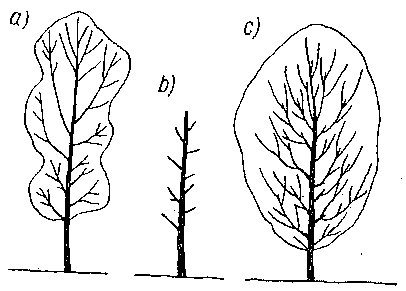 Cutting the distorted tree crown for a more natural plant habit: a) tree distorted due to strong plant compactness, b) way of cutting, c) tree with a newly formed crown.
Only experienced workers can make such cuts. If you want to obtain a completely artificial cut or a specific shape of the plant by cutting, the cutting process must be systematically performed one or several times during the growing season.. The most common examples of artificial forms of single plants are various conifers, e.g.. cis, formed by frequent cutting in the shape of a ball, cone or column.
In many gardens around the world by ,proper cut, and often auxiliary structures, plants were given various shapes resembling various objects, Animals, and even human figures. Cut hedges are a very common example of giving artificial shape to shrubs growing in compact systems.
The cutting of plants in a hedge is carried out quite intensively from the first years in order to obtain as many shoots as possible. A high density of shoots allows you to achieve the required compactness of the hedge and a more even surface. The post-planting pruning should be as short as possible and should be made separately for each bush. Only in the following years, after obtaining a high density of shoots, the cuts can be made in a specific plane.
The cut surfaces can be flat or curved. The transverse shape of the hedge can vary, the best hedges though, because evenly compacted from the bottom, is obtained by giving their side walls a certain slope, causing the width to decrease towards the top. As a result, better illumination of the side walls is obtained, which stimulates the growth and propagation of the shoots.
Obtaining a hedge well compacted from the bottom depends to a large extent on the quality of the shrub used and its natural ability to later regrowth. Each hedge should have a uniform density along its entire length and should be uniform on both sides. Maintaining uniformity is sometimes hindered by closely growing and shading trees or large shrubs, nearby buildings etc.. The uniformity of lighting is favored by the location of the hedge in the north-south direction.
If the top of the hedge is flat, it is very important to make the cut in one plane, resulting in a smooth hedge surface, without protrusions and depressions. Such cuts are usually made with the help of stretched cords or long slats supported on properly positioned poles..
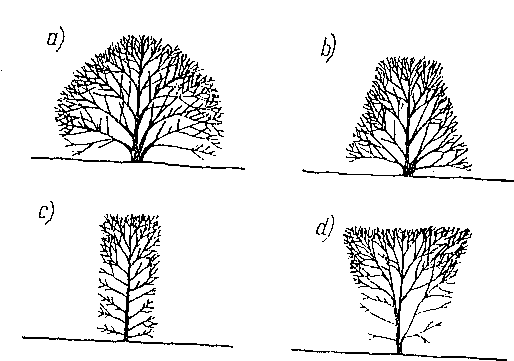 Hedges cross sections: a) i b) with a large number of side shoots in the lower parts, c) i d) with a small number of such shoots.