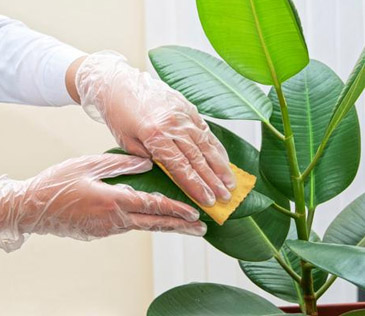
 An indispensable procedure in the home cultivation of potted plants is also washing them. Plants of large, smooth leaves are washed off with a damp sponge or cotton wool on both sides of the leaf blade. Household dust clogs respiratory stomata and inhibits assimilation. Plants resistant to fluctuations in humidity can be exposed outside the apartment to mild summer rain (pay attention to the intensity of sunlight) or rinse under a fine-drop shower. Plants with mossy and hairy leaves must not be sprinkled or rinsed (np. pelargonium, African violet or the violet vulture). Also, do not touch any young parts of the plant – tops of shoots and flower buds or young leaves, as it may distort them.
Most of the potted plants come from the tropics. Therefore, they require moisture and warmth in the room. Hence, in rooms with central heating, an essential procedure is air humidification. Air humidity is increased by spraying water around the plants and by using water evaporation devices. For example, you can put a pot with a plant in a larger container filled with wet peat and systematically moisten the peat. – (african violet) or in a vessel filled with stones and water, yes, by nie dotykała ona dna doniczki (azalea).
Plants also need a macro- and micronutrients
alimentary. When properly fertilized, they grow lush and healthy, maintaining the appearance characteristic of a given genus and species. The basic macronutrients are: azote, phosphorus and potassium. The former affects leaves and green parts. Its deficiency is manifested by poor plant development, the light green color of the leaves is characteristic. Other – affects the root system and flowers, while the third – on flowers, which, in the event of its deficiency, are small and poorly colored, the plant then also has weak stems. The soil of the potted flowers should be fertilized from spring to autumn once a week or every 10th…14 days with a full-component fertilizer mixture – np.: Florovite, Flora or Flos – ściśle według przepisu. Sensitive plants are fertilized with aqueous solutions of fertilizer mixtures at a concentration of 0.1…0,2%. The fertilizer solution is poured onto the moist soil in the pot. Dry potted plants must not be fertilized, it is also not allowed to pour the solution on the stems and leaves. Young and freshly transplanted plants are not fertilized.
If the shoots and leaves grow slowly, despite proper care and appropriate conditions, the earth dries up quickly, despite proper watering, or roots will sprout, they come out through a hole in the pot - the plant must be transplanted and placed in a visible place, away from direct sunlight, moisten the air and soil in the pot. After one week, move the plant to a permanent place. For transplanting, compost soil enriched with mineral fertilizers should be used, selecting soil mixtures for individual plant species.
You mustn't overdo it (and move around at all) potted plants in the phase of forming flower buds.