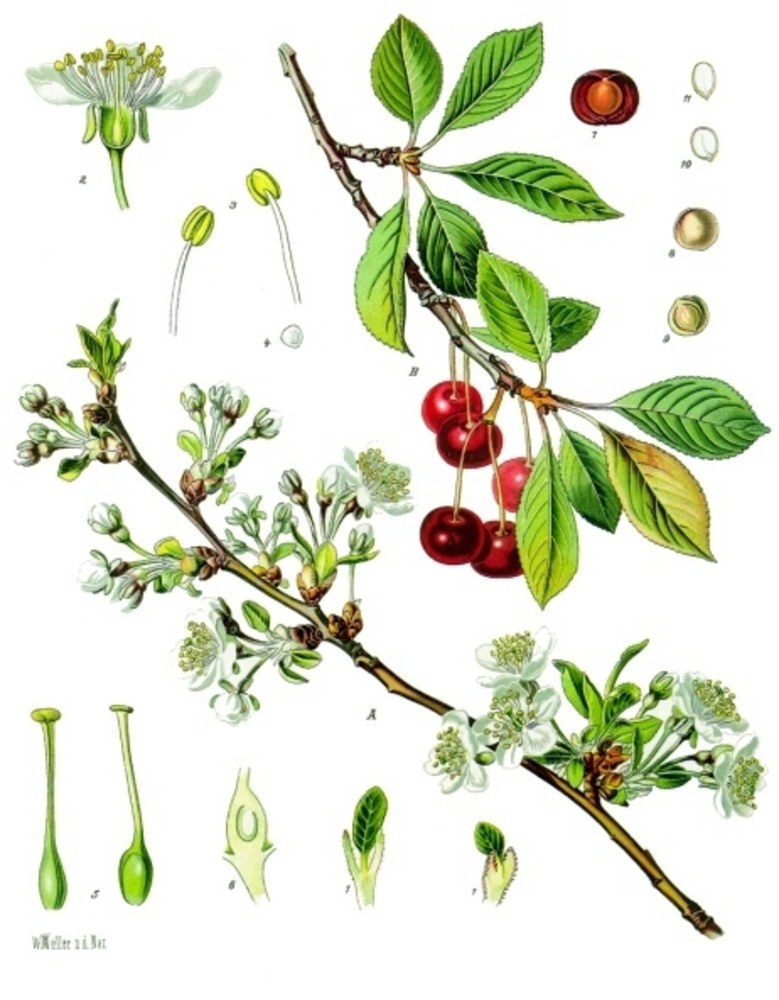
 Common cherry (Prunus cherry)
Appearance: A smaller tree or an overgrown shrub reaching up to 6-5 m in height, with very wide, loose, a slightly irregularly shaped crown on a low trunk, which, just above the ground, divides into numerous branches, roughly the same thickness.
Brown-red bark, a bit shiny, Smooth shoots, naked, quite thin and standing wide apart, often pendulous.
Leaves long 3-8 cm and width 2-5 cm, they are ovate or elliptical in shape, with only a slightly separated tip, wedge-tapered at the base, gently serrated or serrated at the edges, A bit leathery to the touch, shiny and smooth on top, underneath it is lighter and only slightly hairy on the nerves. Petiole long 1-3 cm, with marked honey glands.
Flowers develop simultaneously with Existence. Individual flowers in two- or four-centimeter stalks, two to six are gathered in loose podbaldach. Crown petals pure white, almost round (do 1,5 cm in length), and the children of the chalice are purple-green.
Fruit-drupe (about 15 mm of thickness), it is roundish, smooth, bright red color. Occurrence: Originally only in Southeast Asia, in Europe it has grown in many varieties and has gone wild in places. As an ornamental plant it is not very attractive compared to other representatives of the same genus and therefore it is hardly ever planted in parks and gardens..
Flowering period: April to May.
General thoughts: Cherries have been grown for a long time. The exact history of their spread in the Mediterranean area and in the more northern parts of Europe can only be partially reconstructed on the basis of archaeological finds. Very different varieties have been and are grown regionally. Black cherry is one of the most famous (Prunus wax-pig m. austere), a little tall tree 5-9 m, with the young, black and red fruit, containing strongly dyed juice and backstage seeds. Glazes (Prunus cerasus var. caproniana) are a bit taller, they have lighter stones with my dyed juice and slightly oblong seeds. The bush cherry is a very old variety (Prunus cerasus var. frutescens), which today you can find only in gardens or in the mountains, The fruit has ovoid pips and is quite light colored. The sour cherry deserves a mention (Prunus cerasus var. morello cherry), which has very small inflorescences and small black and red, bitter fruit, from which the famous maraschmo liqueur is made. The sweet cherry is related to the cherries discussed so far (Prunus mahaleb), occurring in warm rock thickets. Small white flowers are collected in podbaldach and placed on the stalks. Both are black fruits, and the seeds are clearly oblong, This species is considered to be an indicator of a climate favorable to viticulture.