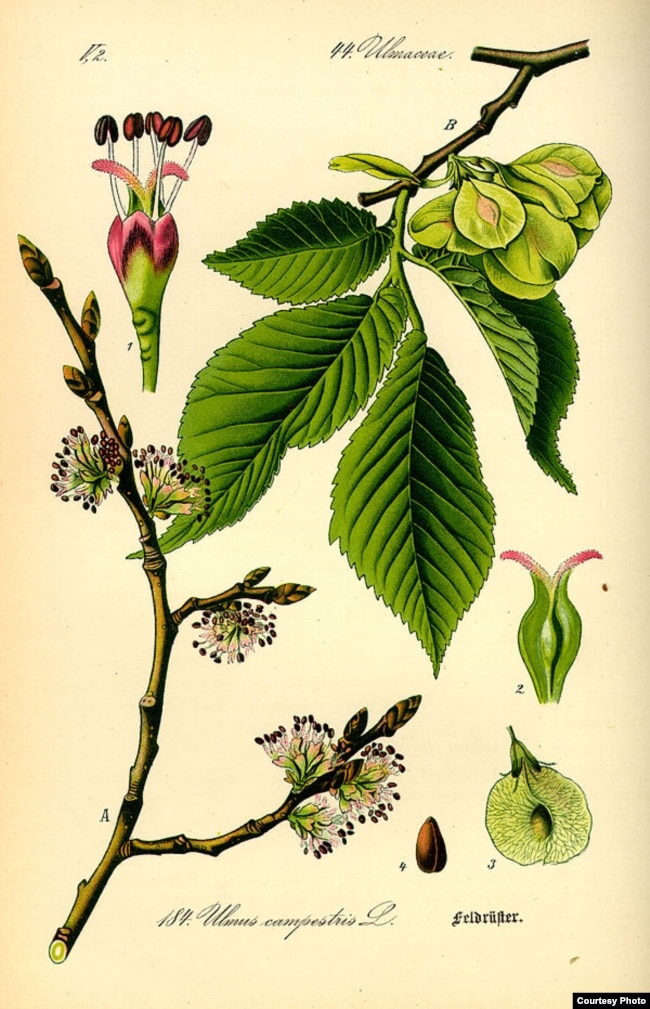
Common elm, field elm (Ulmus carpinifolia)
Appearance: A tree that sheds its leaves for winter, up to approx. 30 meters. Multiform crown – in the typical form usually highly vaulted, but at the same time narrow.
Branches relatively short, strong, protruding almost horizontally. Branches on them rather heterogeneous; side sometimes bent and hanging. Brown-gray bark, with long rather deep furrows and hunched slats, Shoots thin, smooth, slightly shiny, brown-red or dark red. Oval donuts, pointed and only slightly pubescent at the top, otherwise shiny, reddish-brown. Thigh with a length 6-10 cm and width 5-8 cm; take on a variety of, variable shapes, although they are predominantly inversely ovoid or oblong, with an elongated narrow apex and strikingly oblique, asymmetrical leaf base. The edge of the leaf is indistinctly double-sawn or only notched, with a, teeth directed towards the top. Mountains on the leaf surface usually shiny and dark green, and the lower – brighter and clearer, bunches of velvety hairs in the corners of larger nerves, and besides, naked.
Inversely ovoid or oblong fruits; peanut clearly above the center.
Habitat: Field elm chooses moist washable soils, often also flooded, alkaline, rich in nutrients. Occurrence; Often found, especially in the valleys of the great European rivers, however, it is found in the north-western part of Central Europe, and in the mountains at most up to 600 m n.p.m,
Flowering period: March General remarks: Field elm is one of the most common elms. Its leaves are somewhat reminiscent of hornbeam leaves, however, in any case, typical for the genus Ulmus oblique, asymmetrical leaf base is easily recognizable. Field elms in recent decades have unfortunately fallen largely victim to elm disease, which in a short time cause the death of even grown trees. The cause of elm death is a harmful fungus, transmitted to healthy trees by bark beetles. Efforts are being made all over the world to invent methods to combat this fungal plague, who first performed at the turn of the century in the Netherlands. All elms are susceptible to it, however, there are some differences in the degree of resistance, Elms growing singly are less often and less attacked than those found in compact stands.
A related species
Dutch elm (Elm x Hollandica) is a hybrid of mountain elm and multiform field elm. Its different varieties are often planted as a park or street tree. Elm wood – formerly due to its high resistance to bending very sought after – today it is not so highly valued as a utility wood. In many products, elements formerly made of elm, have been replaced by other plastics.