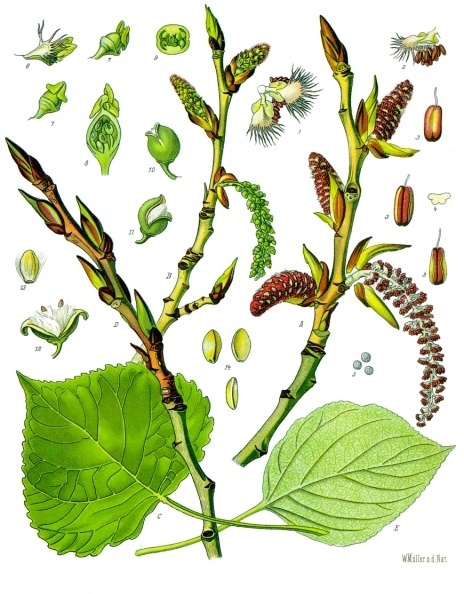
 Black poplar (black people)
Appearance: A stately tree that grows up almost 30 m in height, with very high, vaulted, often with a spreading crown, which, especially in old trees, may appear multi-part and quite irregular,
The trunk is usually very well developed, twisted, often a bit bent over, with thickenings and already at a low height above the ground divided into a few, very thick and massive branches, oblique or arched elevating.
Twigs and annual shoots quite thin, light brown. Tight donuts, pale brown.
Leaves on long shoots have 5-9 cm in length, they are long-tailed, triangular or ovoid-rhombic in outline, with elongated, with a slender top and small ones, front notches on the edges. The leaves on the short shoots are generally shorter. All leaves are reddish green when young, however, they soon turn shiny and dark green.
Gray and white male cats with reddish anthers are approx 5 centimeters. Greenish female cats.
Habitat: It prefers moist soils, periodically flooded, on deep sand or gravel. Occurrence: Wild only in the valleys of the great rivers of Central and Southern Europe, however, in many areas it is planted and used as a park tree.
Flowering period, March to April. Related species
Bristle-fruit poplar (Popuius trichocarpa) it is native to North America and is distinguished by a more slender crown and circle-shaped-heart-shaped leaves, the base of which is usually truncated or wedge-shaped into a long petiole. The tall ones, usually slender trees have a very transparent crown. Often planted in parks or artificial afforestation, Chinese large-leaved poplar (People lasiocarpa) it has strikingly large leaf blades measuring approximately 30×30 cm and thus the largest of all poplar species, occurring in the same region. In addition, the red petioles attract attention, As an ornamental tree, it has not been used very often so far; you can only find her in great collections and botanical gardens. Berlin Poplar (Popuius x bero linen)is a hybrid, the black poplar was probably involved in the uprising (but compare with the next group). Its narrow profile draws attention, dense crown with almost vertically protruding branches, The leaf petioles are rounded. and the leaf plates – narrow wedge. It resembles the italica form of the black poplar, however, it has finer leaves.
The very small seeds of poplar are hidden in fluffy bunches of seed hairs, thanks to which large amounts of seeds are dispersed by the wind. In extensive poplar stands, during the fruiting season, it sometimes gives the impression of freshly fallen snow.